What Does PM Mean on Facebook and How Does It Work in 2026?

What Does PM Mean on Facebook? If you’ve spent any time on social media, chances are you’ve seen someone say, “PM me,” “Send me a PM,” or “Check your PMs.” For many people — especially those newer to Facebook or online messaging culture — the phrase can feel confusing at first.
Does “PM” mean a secret message? Is it the same as Facebook Messenger? Why do people use it instead of simply saying “text me”?
These questions are incredibly common because digital communication keeps evolving. Short forms, abbreviations, and internet slang now shape how people interact online. On Facebook in particular, “PM” became one of the most recognizable communication terms long before messaging apps exploded into everyday life.
Understanding what “PM” means on Facebook is more than learning internet slang. It helps you communicate naturally, avoid awkward misunderstandings, and understand the social tone behind online conversations.
In this guide, you’ll learn the exact meaning of PM on Facebook, where it came from, how people use it emotionally and socially, and when you should — or shouldn’t — use it yourself.
What Does PM Mean on Facebook? — Quick Meaning
On Facebook, PM stands for Private Message.
It refers to a direct conversation sent privately between two people instead of posting publicly on someone’s profile, page, or comment section.
Today, PMs on Facebook usually happen through Facebook Messenger.
Simple Definition
A PM is:
- A one-on-one private message
- Hidden from public comments
- Used for personal conversations
- Often more direct or confidential
Common Examples
- “Can you PM me the details?”
- “I’ll send you a PM later tonight.”
- “Please PM your address.”
In most cases, people use “PM” when they want to move a public conversation into a more personal space.
What Does PM Mean on Facebook Messenger
On Facebook Messenger, PM means Private Message. It refers to a personal conversation sent privately between two users instead of posting publicly on Facebook. Today, Messenger is the main tool people use for PMs on Facebook.
What Does PM Mean on Facebook App
In the Facebook app, PM stands for Private Message or sometimes Personal Message. When someone says “PM me,” they usually want you to continue the conversation through Facebook Messenger instead of comments.
Origin and Background
The term “PM” existed long before Facebook became popular.
In the early internet days — especially in forums, chatrooms, and online gaming communities — people used “private message” systems to communicate privately with other users. Platforms like bulletin boards, IRC chats, and online communities helped popularize the abbreviation.
When Facebook launched messaging features in the mid-2000s, users naturally carried over the same internet language.
Over time, “PM” became deeply tied to online culture because people needed a quick way to say:
- “Let’s talk privately.”
- “Don’t post that publicly.”
- “I’ll explain in direct messages.”
As social media evolved, new terms appeared:
- DM = Direct Message
- Inbox me
- Slide into DMs
- Message me privately
Still, “PM” remained especially common among Millennials, Facebook groups, online sellers, community admins, and older internet users.
Interestingly, the meaning also evolved emotionally. Early PMs were mostly practical. Today, they can feel more personal, intimate, confidential, or even flirtatious depending on context.
Social media changed not just language, but the emotional weight behind digital communication.
How Do You PM Someone on Facebook
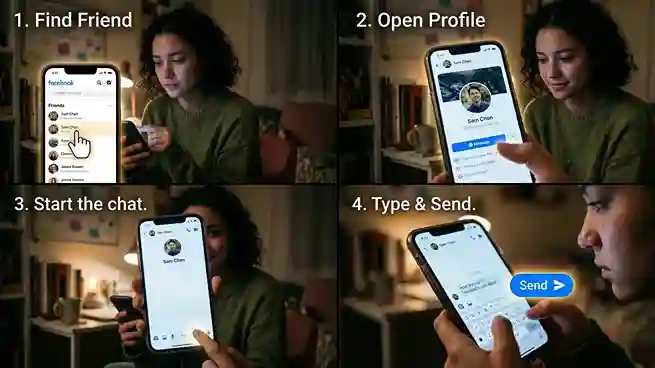
To PM someone on Facebook:
- Open Facebook or Messenger
- Search for the person’s profile
- Tap “Message”
- Type your text
- Press Send
Your message will appear privately in their Messenger inbox.
DM or PM on Facebook
Both DM and PM mean private conversations, but there’s a small difference in usage:
- PM = Private Message
- DM = Direct Message
On Facebook, older users often say “PM,” while younger users may say “DM.” Both usually refer to Messenger chats.
Real-Life Conversations
WhatsApp Conversation
1st Person:
“Hey, I saw your Facebook post about apartments.”
2nd Person:
“Thanks. PM me your budget and location.”
Instagram DM Conversation
1st Person:
“Your photography is amazing.”
2nd Person:
“Thank you so much. PM me if you want booking details.”
TikTok Comments
1st Person:
“Where did you buy that hoodie?”
2nd Person:
“I’ll PM you the link because comments keep deleting it.”
Text Message
1st Person:
“Why did Sarah tell me to PM her?”
2nd Person:
“She probably didn’t want everyone reading the conversation.”
What Does PM Mean on Snapchat
On Snapchat, PM also means Private Message. It refers to chats, snaps, or conversations shared privately between users instead of public stories or comments.
How to Check PM on Facebook
To check your PMs on Facebook:
- Open the Facebook app or Messenger app
- Tap the Messenger icon
- Open your chat list
- Select any conversation to read messages
Your PMs appear inside Messenger inbox conversations.
Emotional and Psychological Meaning
At first glance, “PM” seems purely functional. But emotionally, it often signals something deeper.
When someone asks for a PM, they’re usually doing one of these things:
- Creating privacy
- Building trust
- Avoiding public attention
- Starting a more personal conversation
- Controlling who sees information
That’s why PMs can sometimes feel more meaningful than public comments.
A public comment is open to everyone. A PM feels selective.
In modern communication, privacy has emotional value. People often move conversations into private messages when topics become sensitive, personal, serious, romantic, or confidential.
A Realistic Scenario
Imagine someone posts:
“I’m struggling lately and need advice.”
A public comment may feel too exposed. But a PM allows empathy without social pressure.
That small shift changes the emotional atmosphere completely.
This is one reason private messaging became central to online relationships, friendships, support communities, and even business networking.
Usage in Different Contexts
Social Media
On Facebook, PM usually means:
- Sending a Messenger message
- Asking for details privately
- Continuing a discussion away from public comments
Example:
“PM me for pricing.”
This is common in Facebook Marketplace and business groups.
Friends & Relationships
Friends often use PM casually when:
- Sharing gossip
- Discussing sensitive topics
- Sending personal photos
- Talking emotionally
In relationships, “PM me” can even feel flirtatious depending on tone.
Example:
“Don’t say it here… PM me.”
Work & Professional Settings
Professionals sometimes use PM on Facebook groups or networking communities.
Example uses:
- Sending resumes
- Sharing invoices
- Discussing collaborations
- Exchanging confidential information
However, in formal workplaces, people usually prefer terms like:
- “Direct message”
- “Email me”
- “Send me a private message”
because “PM” can sound slightly informal.
Casual vs Serious Tone
The tone changes depending on context.
Casual:
“PM me the meme.”
Serious:
“Please PM your contact information for verification.”
The same abbreviation can sound playful or highly professional depending on the wording.
Meaning of PM in WhatsApp Chat
In WhatsApp chats, PM usually means sending a private or direct message to someone personally. Since WhatsApp is already private, people use “PM” mainly when moving a conversation from a group chat to a personal chat.
Example:
“PM me your number.”
When NOT to Use It
Although PM is common, there are situations where it may create confusion or seem inappropriate.
Formal Business Communication
In highly professional settings, saying “PM me” may sound too casual.
Instead, use:
- “Please email me”
- “Send me a direct message”
- “Contact me privately”
Sensitive Situations
Asking someone to PM you during public conflict can appear manipulative or secretive.
Example:
- Public arguments
- Community disputes
- Transparency-related issues
Cultural Misunderstandings
Not everyone understands internet abbreviations equally.
Older users or non-native English speakers may confuse PM with:
- Prime Minister
- Evening time (PM vs AM)
- Project management
Clarity matters.
Suspicious Requests
Scammers often say:
“PM me for details.”
This can sometimes raise trust concerns online, especially in buying/selling groups.
What Is the Meaning of PM in Message
In messaging apps and online conversations, PM means Private Message. It describes a message only visible to the sender and receiver, not the public.
People use PMs for:
- Personal conversations
- Private details
- Sensitive topics
- One-on-one communication
Common Misunderstandings
One major misunderstanding is thinking that PM and Messenger are completely different things.
In reality:
- PM = the action
- Messenger = the platform/tool
Another confusion involves tone.
Some people assume “PM me” sounds secretive or romantic. Others see it as purely practical.
Context changes everything.
People also misunderstand urgency.
Example:
“PM me ASAP.”
This can feel aggressive to some users, while others interpret it as normal online shorthand.
Digital communication lacks facial expressions and voice tone, which is why misunderstandings happen so easily online.
Comparison Table
| Expression | Meaning | Tone | Common Platform |
| PM | Private Message | Neutral | |
| DM | Direct Message | Modern/Casual | Instagram, X, TikTok |
| Inbox Me | Send a message privately | Friendly | |
| Text Me | Phone messaging | Personal | SMS |
| Email Me | Formal communication | Professional | Work/Business |
| Public Comment | Visible to everyone | Open | Social media |
| Slide Into DMs | Flirtatious messaging | Playful | Instagram/TikTok |
Key Insight
While PM and DM are very similar, “PM” often feels slightly older and more Facebook-centered, while “DM” sounds newer and more social-media trendy.
Variations / Types
1. PM Me
A direct request asking someone to send a private message.
2. Send a PM
A slightly more formal version of “PM me.”
3. Check Your PMs
Tells someone they already received a private message.
4. Private Inbox
Another phrase meaning private messaging area.
5. DM Me
Modern alternative commonly used on Instagram and TikTok.
6. Inbox Me
Facebook-style phrase for private conversation.
7. Slide Into DMs
Playful phrase usually connected to flirting.
8. Direct Message
Full professional version of DM.
9. Personal Message
An older internet term similar to PM.
10. Message Me Privately
Clear, beginner-friendly version without slang.
How to Respond When Someone Uses It
Casual Replies
- “Sure, I’ll PM you now.”
- “Just sent you a PM.”
- “Check your inbox.”
Funny Replies
- “Entering the secret chat zone now.”
- “Deploying private message technology.”
- “Your PM has arrived with dramatic music.”
Mature Replies
- “I’d be happy to discuss this privately.”
- “I’ll send the details shortly.”
- “Thanks for reaching out privately.”
Respectful Replies
- “I appreciate your discretion.”
- “Thank you for messaging privately.”
- “I’ll respond as soon as possible.”
Regional & Cultural Usage
Western Culture
In Western online culture, PM is widely understood as standard internet slang.
It’s common in:
- Facebook groups
- Marketplace listings
- Gaming communities
- Parent groups
- Local communities
Millennials especially still use “PM” frequently.
Asian Culture
In many Asian countries, younger users now prefer “DM” because Instagram, TikTok, and mobile-first apps dominate communication.
However, Facebook communities still heavily use “PM” for buying, selling, and networking.
Middle Eastern Culture
Privacy is often culturally significant in online communication across many Middle Eastern communities.
Asking someone to PM can feel more respectful than discussing personal matters publicly.
Global Internet Usage
Globally, PM remains understandable even if DM is becoming more fashionable.
Facebook users over 30 still commonly say:
- “PM me”
- “Inbox me”
Younger audiences lean toward:
- “DM me”
Generational Differences
Gen Z
Prefers:
- DM
- Slide into DMs
- Message me
Millennials
Frequently use:
- PM
- Inbox me
Older Users
Often use full phrases like:
- “Send me a private message.”
Language online changes with digital generations.
Is It Safe for Kids?
Yes, the term itself is generally safe.
However, parents should understand that private messaging removes public visibility. Kids should learn:
- Not to share personal information
- To avoid strangers requesting private chats
- To recognize suspicious behavior online
Context matters more than the abbreviation itself.
FAQs
How do you send a PM on Facebook?
Open Facebook Messenger, choose the person, type your message privately, then press send to start the conversation instantly.
How does someone PM you on Facebook?
They open Messenger, search your profile, and send a private message directly to your inbox for personal communication.
How do I check my PM on Facebook?
Open Facebook Messenger or tap the Messenger icon inside Facebook to view all received private messages and conversations.
How do I enable PM on Facebook?
Go to Facebook privacy and Messenger settings, then allow message requests from friends, followers, or selected users accordingly.
How do I receive a PM on Facebook?
Keep Messenger active, enable notifications, and ensure your privacy settings allow others to contact you through messages.
Is PM the same as Messenger on Facebook?
Not exactly. PM means private message, while Messenger is Facebook’s app and platform used to send those messages.
Conclusion
So, What Does PM Mean on Facebook? “PM” on Facebook may look like a tiny abbreviation, but it reflects something much bigger about modern communication: the need for privacy, connection, and direct conversation in a public digital world.
Whether someone uses it casually, professionally, emotionally, or humorously, the phrase has become part of how people navigate relationships online.
Understanding what PM means helps you communicate more naturally and confidently — especially in social spaces where tone and context matter just as much as words themselves.
And while internet language keeps evolving, one thing remains true: people still value private conversations when they want authenticity, trust, or genuine human connection.
So the next time someone says, “PM me,” you’ll know exactly what they mean — and why it matters.