What Does IDC Mean in Texting? Complete Meaning & Examples

If you’ve ever received a message saying “IDC” and wondered whether the person was angry, upset, or simply uninterested, you’re not alone. Many people search what does IDC mean in texting because the abbreviation can sound cold without the context behind it.
Texting has changed the way we communicate. Short expressions save time, but they can also hide emotions. A simple three-letter acronym like IDC can mean anything from genuine indifference to frustration, sarcasm, or emotional exhaustion.
In this guide, you’ll learn exactly what IDC means, where it came from, how people use it across social media and messaging apps, and when you should avoid using it. By the end, you’ll feel confident understanding and using IDC naturally in everyday conversations.
What Does IDC Mean in Texting? – Quick Meaning
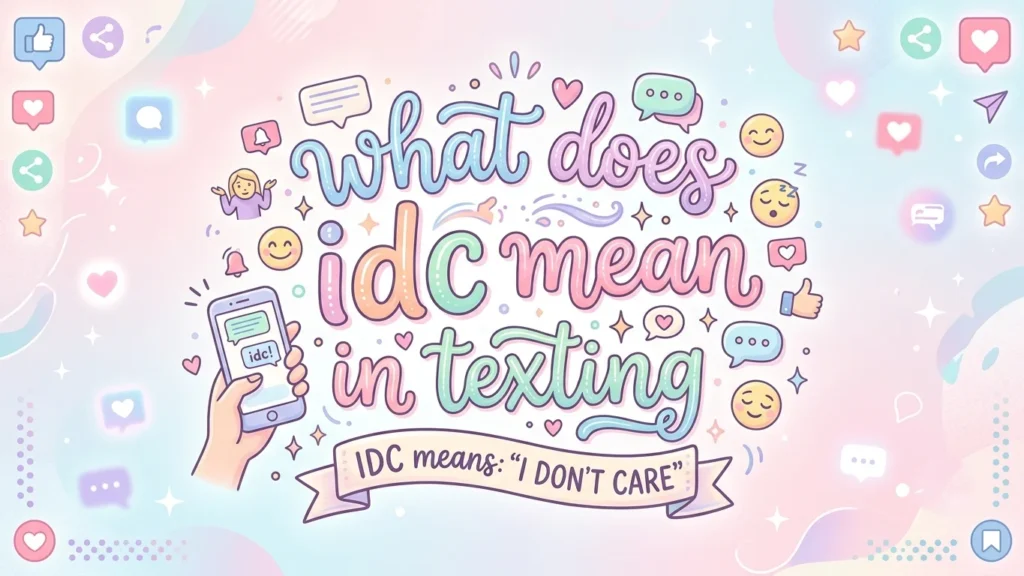
In texting, IDC stands for “I Don’t Care.”
It expresses a lack of concern, interest, or preference about something. Depending on the conversation, it may sound relaxed, dismissive, annoyed, or emotionally detached.
Quick Definition
- Full form: I Don’t Care
- Tone: Neutral, casual, annoyed, or rude depending on context
- Used in: Text messages, WhatsApp, Instagram, Snapchat, TikTok, Discord, and online chats
- Purpose: To show indifference or that something is unimportant
Examples
“IDC where we eat. You choose.”
“IDC what they think anymore.”
“Honestly, IDC if it rains today.”
The same abbreviation can feel friendly among close friends but harsh in a serious conversation.
Origin & Background
IDC became popular during the early days of online chatrooms, SMS texting, and internet forums in the late 1990s and early 2000s. Since text messages had strict character limits, people naturally shortened common phrases.
As smartphones and social media platforms grew, IDC became part of everyday digital language.
Today, you’ll see it used on:
- Instagram DMs
- Snapchat
- TikTok comments
- X (formerly Twitter)
- Discord
- Gaming chats
Interestingly, the emotional meaning of IDC has evolved. Years ago, it mostly meant simple indifference. Today, it can also express emotional burnout, disappointment, or an attempt to end an argument without saying much.
Context has become just as important as the words themselves.
Real-Life Conversations
1st Person:
“I honestly IDC what movie we watch.”
2nd Person:
“Perfect. I’ll pick one then.”
Instagram DMs
1st Person:
“They unfollowed me.”
2nd Person:
“IDC anymore. Life’s too short.”
TikTok Comments
1st Person:
“IDC what anyone says, this song is amazing.”
2nd Person:
“Exactly. It’s been on repeat all week.”
Text Messages
1st Person:
“Should we cancel the trip?”
2nd Person:
“IDC either way. Whatever works for everyone.”
These conversations show that IDC doesn’t always mean someone is angry. Sometimes they’re simply leaving the decision to someone else.
Emotional & Psychological Meaning
Words often communicate feelings beyond their literal meaning, and IDC is no exception.
People use IDC for several emotional reasons:
- They’re genuinely flexible.
- They’re tired of arguing.
- They feel emotionally hurt.
- They want to hide disappointment.
- They no longer want to invest energy in the situation.
I’ve noticed that many conversations become clearer when people explain why they “don’t care.” Without that explanation, IDC can easily be misunderstood as rejection or disrespect.
Imagine someone who has spent hours debating weekend plans with friends. After endless messages, they finally reply, “IDC anymore.” They’re probably exhausted rather than uncaring.
That’s why understanding emotional context matters more than the abbreviation itself.
Usage in Different Contexts
Social Media
IDC often appears in captions and comments to express confidence or ignore criticism.
Example:
“IDC if this trend is unpopular. I love it.”
Friends & Relationships
Friends frequently use IDC when they genuinely have no preference.
Example:
“IDC where we grab coffee.”
However, during emotional conversations, it may sound dismissive.
Work or Professional Settings
IDC is generally inappropriate in professional communication.
Instead of saying:
“IDC.”
Try:
“I’m comfortable with either option.”
or
“I don’t have a strong preference.”
Professional wording maintains respect and avoids misunderstandings.
Casual vs Serious Tone
In casual chats, IDC often sounds relaxed.
During emotional discussions, however, it can appear insensitive or uncaring.
The relationship between the people involved usually determines how the message is received.
When NOT to Use It
Although IDC is common, there are situations where it’s better avoided.
Avoid using IDC when:
- Someone is sharing personal struggles.
- A family member needs emotional support.
- You’re speaking with your manager or client.
- The conversation involves conflict resolution.
- Someone is asking for sincere advice.
Using IDC during sensitive moments may unintentionally hurt someone’s feelings, even if that wasn’t your intention.
Showing empathy usually strengthens communication far more than ending a conversation abruptly.
Common Misunderstandings
Many people assume IDC always means the speaker is rude.
That isn’t necessarily true.
Here are some common misconceptions:
“IDC means someone is angry.”
Not always. They may simply have no preference.
“IDC means they don’t like me.”
Sometimes it refers only to the topic being discussed, not the relationship.
“IDC is always disrespectful.”
Among close friends, it can be completely harmless.
“IDC literally means zero emotions.”
In reality, people sometimes say IDC because they’re emotionally overwhelmed.
The emotional tone depends heavily on timing, punctuation, and previous messages.
Comparison Table
| Expression | Meaning | Tone | Opposite |
|---|---|---|---|
| IDC | I Don’t Care | Neutral to dismissive | I Care |
| IDK | I Don’t Know | Uncertain | I Know |
| NVM | Never Mind | Ending discussion | Continue Talking |
| Whatever | No preference or frustration | Casual or annoyed | Absolutely |
| Fine | Acceptance, sometimes reluctant | Neutral | Refuse |
| Sure | Agreement | Positive | No |
Key Insight
IDC is different from simply being unsure. It communicates a lack of concern rather than a lack of knowledge. Understanding that distinction helps prevent many texting misunderstandings.
Variations & Related Expressions
IDRC
“I don’t really care.”
Shows mild indifference rather than complete dismissal.
IDC TBH
“I don’t care, to be honest.”
Adds honesty or emphasis.
IDC Anymore
Suggests emotional exhaustion or moving on.
IDC Either Way
Shows flexibility between options.
IDC LOL
Softens the statement with humor.
IDC Fr
“I don’t care, for real.”
Adds sincerity and emphasis.
IDC Bro
Casual expression commonly used among friends.
IDC Honestly
Emphasizes genuine indifference.
IDC What People Think
Expresses confidence and independence.
IDC About That
Specifically dismisses one topic rather than everything.
How to Respond When Someone Uses IDC
Casual Replies
- “Sounds good.”
- “I’ll decide then.”
- “No worries.”
Funny Replies
- “Thanks for making the decision easier!”
- “Your enthusiasm is inspiring.”
- “I’ll pretend that was passionate.”
Mature Replies
- “Are you okay with either choice?”
- “I just wanted your opinion.”
- “Thanks for letting me know.”
Respectful Replies
- “I appreciate your honesty.”
- “We’ll choose what works best.”
- “Let me know if you change your mind.”
These responses keep conversations positive while avoiding unnecessary conflict.
Regional & Cultural Usage
Western Culture
IDC is widely accepted in casual texting among friends. Direct communication styles often make it feel normal.
Asian Culture
In many Asian cultures, harmony and politeness are valued. Saying IDC directly may seem overly blunt unless used with close friends.
Middle Eastern Culture
People often prefer warmer and more respectful expressions during personal conversations. IDC may sound colder than intended.
Global Internet Usage
Across social media, IDC is recognized almost everywhere as “I Don’t Care.” Younger users often understand it instantly.
Gen Z vs Millennials
Gen Z frequently uses IDC in memes, jokes, and casual conversations.
Millennials also understand it but may use the full phrase more often during important discussions.
Despite generational differences, context remains the biggest factor in interpretation.
Is It Safe for Kids?
Yes, IDC itself is not offensive or inappropriate.
However, children should understand that saying “I don’t care” repeatedly may come across as disrespectful or dismissive. Teaching respectful communication helps them express opinions without hurting others’ feelings.
FAQs
What is IDC in Gen Z?
Among Gen Z, IDC usually means “I Don’t Care,” expressing confidence, indifference, emotional detachment, or simply having no strong preference today.
Is IDC a rude word?
IDC isn’t inherently rude. Its tone depends entirely on context, relationship, wording, punctuation, and the emotional situation surrounding the conversation.
What does IDC mean in chat?
In chat, IDC means “I Don’t Care,” showing someone lacks concern, preference, or emotional investment regarding the discussed topic or decision.
What is IDC in TXT?
In TXT or text messaging, IDC simply abbreviates “I Don’t Care,” making conversations shorter, faster, and easier to type quickly.
What does a girl mean when she says IDC?
A girl saying IDC may express flexibility, frustration, disappointment, confidence, or emotional exhaustion depending entirely on conversation context and relationship dynamics.
What does DC mean in Gen Z?
DC usually means “Don’t Care,” “Disconnect,” or “Dance Challenge,” depending on the platform, conversation, and surrounding context being discussed.
Conclusion
Understanding what does IDC mean in texting is about more than memorizing an abbreviation. While it literally stands for “I Don’t Care,” its real meaning depends on context, emotion, and the relationship between the people communicating.
In casual conversations, IDC often signals flexibility or indifference. In emotional discussions, it can unintentionally sound dismissive or hurtful. Learning to recognize these differences helps you avoid misunderstandings and communicate with greater confidence.
The next time you see IDC in a message, don’t judge it by the letters alone. Consider the conversation, the person’s tone, and what they’re really trying to express. That small habit can make digital communication feel much more human.